ADELAIDE PLANT RECOVERY Royal Adelaide Show · 5-13 September 2026
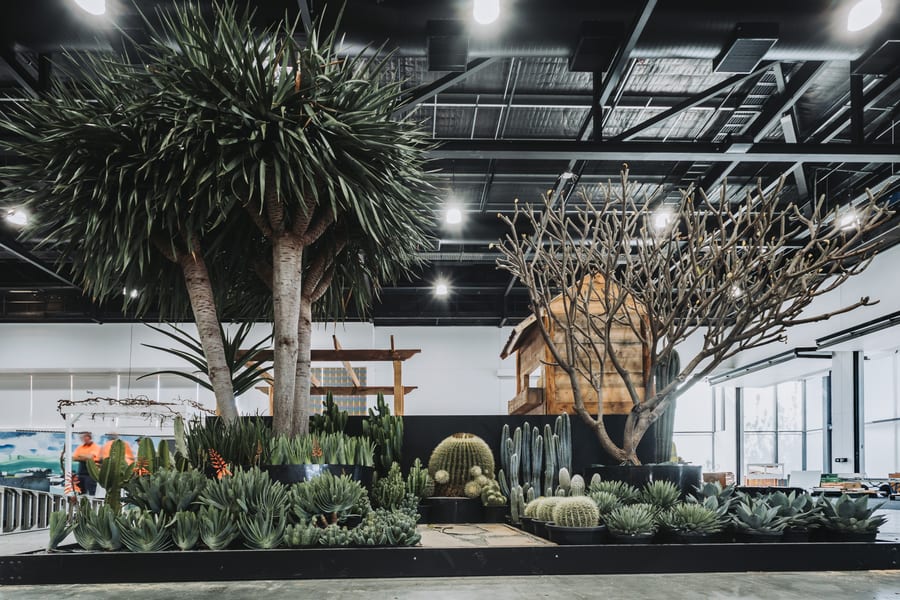
The display garden seen head on: dragon trees at the left-hand end, a bare frangipani at the right, and a bed of agaves, golden barrels and columnar cactus running between them

Adelaide Showground, Wayville · 5-13 September 2026

The Display Garden

Sixteen plants, and an ocean between the two ends of it. Every one of them was grown on, dug out of somewhere it was no longer wanted, and kept alive to stand here.

Two continents, one shape

Walk this garden from left to right and you cross an ocean. Everything at the left-hand end grew up in Africa and Arabia. Everything at the right-hand end came from the Americas. They have never shared a continent, a pollinator or an ancestor worth mentioning.

And yet look at them. The same fat water-storing columns, the same armour, the same ribs that let a plant swell after rain and shrink through a drought. Two sets of plants, half a world apart, arriving at the same answer because they were asked the same question.

Here is the thing worth knowing before you walk it: not one plant on the African side is a cactus. Every cactus-shaped plant down that end is a euphorbia: a different family entirely, one that happens to look the part. All true cacti are American. Nowhere else.

The left-hand end

Africa & Arabia

Seven plants from the dry side of the Old World. Three of them look like cactus. None of them is.

Southern Africa

Cowboy Euphorbia

Euphorbia ingens

Euphorbia, not a cactus

Everyone calls it a cactus. It is not one, and it is not close. Break a stem and it bleeds a thick white latex that will burn skin and take an eye, which is why farmers across southern Africa have planted it as living stock fencing for generations, and why nothing much grazes on it. Twelve metres in the veld. In a garden it is the plant people stop walking to look at.

Grows wildSouth Africa, Zimbabwe, Mozambique

Ask about this plant

Arabian Peninsula

African Candelabra

Euphorbia ammak

Euphorbia, not a cactus

Off the Red Sea escarpment, where it grows out of bare rock on almost nothing. Stand it beside the big Mexican cardon at the far end of this garden and most people cannot pick which is which: one is a euphorbia from Arabia, the other a cactus from Baja California, and they have never shared a continent. Ours is the plant everybody photographs and calls a saguaro. It is not that either.

Grows wildWestern Saudi Arabia and northern Yemen

Ask about this plant

Arabian Peninsula

Ghost Euphorbia

Euphorbia ammak 'Variegata'

Euphorbia, not a cactus

Look past it in the photograph and there is a green one standing right there, same species, same ribs, same spines. This one carries a fault that stops it making chlorophyll, so instead of green it comes out the colour of bone with pink on every new tip. The fault costs it: it grows slower than the green form, sunburns where the green one would not care, and it will never be produced in quantity. Which is precisely why one this size is worth several times its green twin, and why it is the plant that stops people mid-aisle.

Grows wildThe wild form grows in western Saudi Arabia and northern Yemen

Ask about this plant

Morocco

Moroccan Mound

Euphorbia resinifera

Euphorbia, not a cactus

The plant that named the family. In about 12 BC a Numidian king, Juba II, named a succulent after his Greek physician Euphorbus, who had been using its latex as a medicine; two thousand years later Linnaeus made that name the genus. The same sap holds resiniferatoxin: the hottest compound ever measured, roughly a thousand times pure chilli heat, and it is back in laboratories now as a painkiller for people nothing else touches. It grows here as a low frost-hardy cushion, metres across, that asks for nothing.

Grows wildThe slopes of the Atlas Mountains

Ask about this plant

Southern Africa

Tree Aloe

Aloidendron barberae

Aloe

Africa's largest aloe. Eighteen metres in the wild, with a trunk you cannot get your arms around, and botanists moved it out of Aloe in 2013, which is why the older labels say Aloe bainesii. What makes it useful here is what it does not do: no invasive roots, so it can stand beside a pool or a paved courtyard where a real tree could never go. Then in the middle of winter, when the garden has given up, it throws rose-pink flowers and the birds arrive.

Grows wildSouth Africa, Eswatini, Mozambique

Ask about this plant

South Africa

Fan Aloe

Kumara plicatilis

Aloe

Every other aloe spirals its leaves. This one lays them flat in a single plane, like a hand of cards, and grows a thick corky bark that lets it walk away from the fires that sweep Cape fynbos. It grows wild in a handful of mountain valleys in the Western Cape and nowhere else on earth. Slow enough that a large one represents a decade or two of somebody's patience, which is the whole reason to own one rather than grow one.

Grows wildA handful of mountain valleys in the Western Cape

Ask about this plant

Canary Islands

Dragon Tree

Dracaena draco

Dracaena

Cut it and the sap runs red. Mediaeval traders shipped it as dragon's blood and it went into varnish, medicine and dye: the story goes, onto Stradivarius violins. It lays down no growth rings, so nobody can tell you how old one is; you count the branchings and guess, which is how the famous tree on Tenerife came to be called a thousand years old with nobody able to prove it. Salt wind, drought, poor soil: none of it bothers this tree. It is the one you plant to be looked at from the street.

Grows wildThe Canaries, Madeira and Cape Verde, off the African coast

Ask about this plant
An ocean, and sixty million years

The right-hand end

The Americas

Nine from the New World, and here is where the real cacti start, because this is the only place on earth they are from.

Mexico

Queen Victoria Agave

Agave victoriae-reginae

Agave

The white lines are not paint or markings. They are the creases each leaf pressed into its neighbours while the whole plant was still folded inside the bud, kept for life like a fold in paper. It grows on limestone cliffs in the Chihuahuan Desert and was named for Queen Victoria in 1875. It will spend twenty or thirty years assembling itself into that perfect dome, flower once, and die, leaving the offsets around its base. The collector's agave, and the reason is in front of you.

Grows wildLimestone cliffs of the Chihuahuan Desert

Ask about this plant

North America

Parry’s Agave

Agave parryi

Agave

The high-country agave, from Arizona, New Mexico and northern Mexico, where it takes snow and hard frost, which is why it sits through an Adelaide winter without complaint when softer agaves rot. The Apache cut the hearts and roasted them in stone pits for days as a staple food; the same practice further south, on other agaves, became mezcal. Silver-blue, tight, architectural, and about as close to unkillable as this garden gets.

Grows wildArizona, New Mexico and northern Mexico

Ask about this plant

Garden hybrid

Blue Glow Agave

Agave 'Blue Glow'

Agave

Bred, not found: a cross between two Mexican species, Agave attenuata and Agave ocahui, made for one effect. Put it where the late sun can get behind it and the red-gold edge of every leaf lights up like a filament. It carries no hooked teeth down the leaf margins either, which makes it one of the few agaves you can plant along a path without it taking an interest in passers-by.

Grows wildBred from two Mexican species, Agave attenuata and Agave ocahui

Ask about this plant

Mexico

Golden Barrel

Echinocactus grusonii

Cactus

Slower than almost anything else in this garden. A barrel the size of a football has been at it for a decade or more and cannot be hurried by feeding, watering or wanting. In the wild it is close to gone: the Zimapán dam drowned much of the single valley it grew in and collectors took a good deal of what the water missed. What survives of the species now is largely in the hands of the people who grow it, which is a strange and rather good thing to be part of.

Grows wildA short stretch of the Moctezuma River valley, Querétaro and Hidalgo

Ask about this plant

Mexico

Giant Golden Barrel

Echinocactus grusonii

Cactus

Not a different plant from the one further along. The same species, several decades further into the job. The reference books give this cactus forty to eighty centimetres across; this one went past that and kept going, and there is no shortcut: nobody grows one of these to order, and nobody can sell you the time it took. It has begun flowering, which golden barrels only do once they are old, in a ring right around the crown. One this size comes up about as often as it flowers.

50 mm to 1,200 mm: the golden barrels in this garden, every one the same species

Grows wildA short stretch of the Moctezuma River valley, Querétaro and Hidalgo

Ask about this plant

Mexico

Old Man Cactus

Cephalocereus senilis

Cactus

The white hair is modified spines, and it works: a sun hat that shades the skin underneath from desert glare while still letting the air through. The joke is that the young ones are the hairiest, and it thins with age. It grows in limestone canyons in Hidalgo, is scarce enough in the wild now to be protected, and asks for a bright spot and almost no water. People name them. It is that kind of plant.

Grows wildLimestone canyons in Hidalgo and Guanajuato

Ask about this plant

Brazil

Blue Torch Cactus

Pilosocereus pachycladus

Cactus

That blue is not a trick of the light. It is a wax the plant makes and wears on the outside as sunscreen, laid on thick: rub a column and it comes away on your thumb, and the plant simply makes more. It comes from the dry caatinga scrub of eastern Brazil, where it opens white flowers at night for bats and closes them before morning. There is no other plant you can put in an Adelaide garden that is this colour.

Grows wildThe dry caatinga scrub of eastern Brazil

Ask about this plant

Mexico

Mexican Giant Cardon

Pachycereus pringlei

Cactus

The tallest cactus on earth (nineteen metres is the record), and they live for centuries, so the ones standing in Baja California now were there before Adelaide was. It manages that on some of the poorest ground in Mexico by carrying bacteria in its roots that break down bare rock into something it can live on. It makes its own soil. Slow, heavy, and the sort of plant a house gets designed around rather than the other way about.

Grows wildBaja California and Sonora

Ask about this plant

Central America

Pink Frangipani

Plumeria rubra

Frangipani

Everybody files this one under Bali. It is Central American, and it only reached Asia and the Pacific on European ships after 1500, which makes the classic Pacific flower a fairly recent arrival there. Here is the better secret: the flower produces no nectar at all. It is large, white and pours out scent at night purely to draw hawkmoths, which arrive, work it over, and leave with nothing. The most generous-smelling thing in the garden is running a con. Deciduous, so it lets the winter sun through and shades you all summer.

Grows wildMexico through to Panama

Ask about this plant

Take one home

Ask about a plant

This is how you ask about anything standing in this garden, and about a great deal more of it back at the nursery. Tell us which plant caught your eye. We will come back to you and get it into your garden or your next project.

Goes straight to Peter. No list, no newsletter.